Summer Ventures in Science and Mathematics
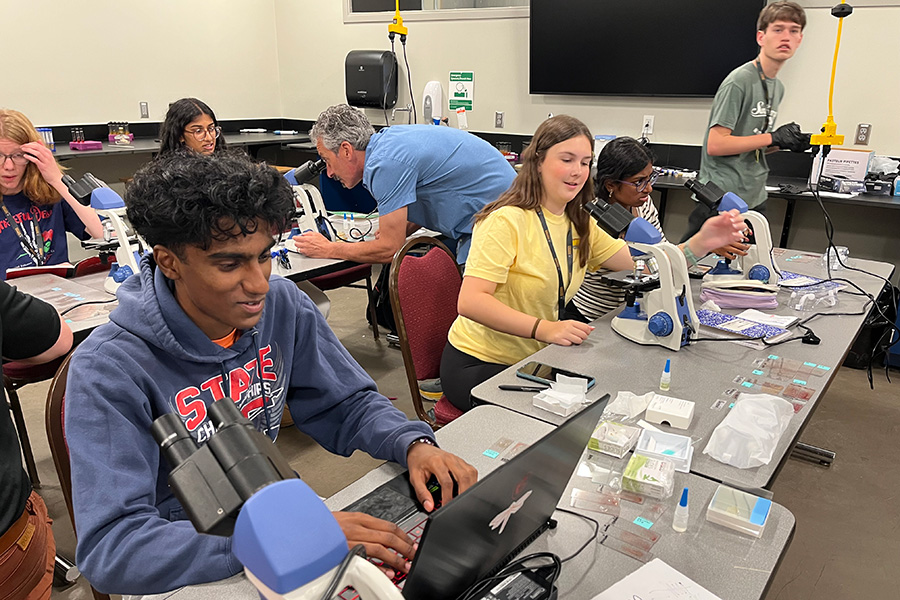
Summer Ventures in Science and Mathematics (SVSM) is a cost-free enrichment program for academically motivated high school students who are potentially interested in careers in science or mathematics. The program provides residential experiences on university campuses during the summer, allowing students to engage in scientific and mathematical research.
SVSM was established by the North Carolina General Assembly in 1984 and is administered through the University of North Carolina System, with coordination by the North Carolina School of Science and Mathematics (NCSSM). Four UNC campuses host Summer Ventures programs:
- Appalachian State University
- East Carolina University
- UNC-Charlotte
- UNC-Wilmington
Academic Experience
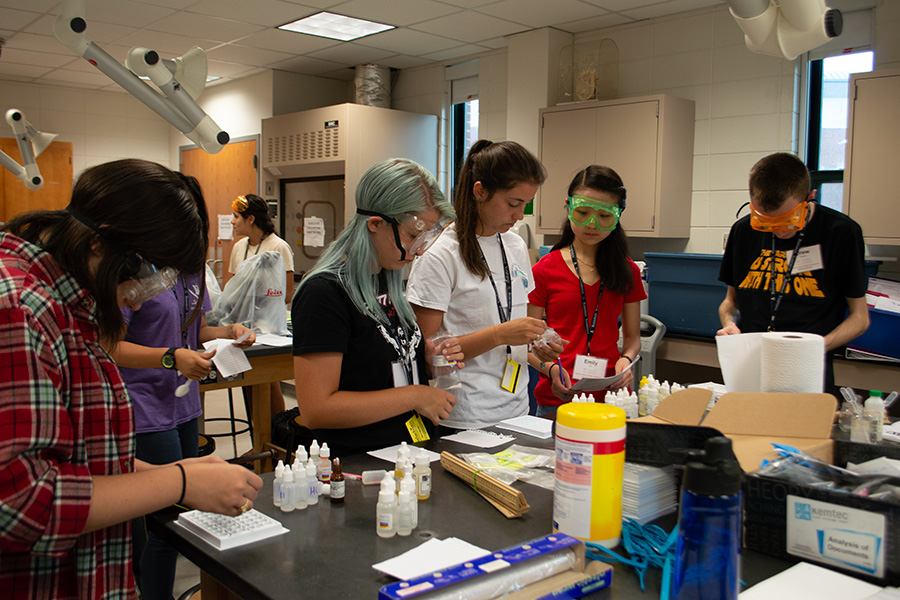
Summer Ventures is a four‑week, residential academic program that immerses students in hands-on research, problem solving, and scientific communication. Participants will work closely with university professors on a collaborative research project, culminating in a written scientific paper and oral presentation. The curriculum is designed to enrich and complement college preparation through coursework and experiences not typically available in high school.
Admissions
Summer Ventures is open to academically motivated North Carolina high school students who demonstrate strong interest in science or mathematics. Students can apply through a statewide admissions process coordinated by NCSSM, with selections made by a committee of education, science, and mathematics professionals. See detailed information about eligibility, application steps, and the selection process.
2026 Program
Dates: June 21 – July 18, 2026
Research Courses
Students review course descriptions and rank course preferences via a Google Form emailed after acceptance. Assignments are based on eligibility and availability; historically, most students receive their first or second choice. You can also view past years’ course descriptions.
Advocating for Planet A
(Climate Change/Data Science)
The concept of a sustainable environment is global in its applicability. Coming to an agreement on how much people want their environment to be sustainable is a difficult issue because of the differences in what people want from their environment. The issues that lead to such disagreements are at once global and local to that particular issue. Humans impact the environment in numerous ways. Climate change is one of them. In fact, climate change can exacerbate the already detrimental effects that humans have on the environment. That is why sustainability should play a large part in how societies function.
In this class, we will be discussing sustainability issues, concentrating on climate change, including many applications of data science. Climate change is still a controversial topic, mainly among the general public and policy makers, and to some extent, among scientists. The outcome of this debate is important to us as a global society because of the policy choices, and ultimately the laws, that will be passed. The policy choices made in different countries will be important to the local communities and to the global society because the effects of climate change are both local and global. We will be learning about the science behind sustainability issues and climate change, and the uncertainties and challenges faced by the scientists and policy makers. We will also learn about how decisions and policies affect such issues and the different stakeholders affected by these issues. Basic scientific concepts will be explained throughout the course and will be enhanced by discussing various academic articles and case studies. Students will also be exposed to how various science disciplines are involved with aspects of sustainability and climate change. Topics such as social change, simulation/sampling, data analysis as well as chemistry, biology, oceanography topics will allow for students to develop unique individual research studies.
Learning Outcomes: The course will concentrate on critical thinking skills, team and leadership building skills, and effective communication, through scholarly articles and case study discussions. This will help students recognize, among other things, human versus natural causes and impacts on the environment, diagnose a problem, and come up with solutions to that problem through analysis and reasoning. Coming up with solutions to widespread problems on the environment, especially problems like climate change will also teach students about the importance and responsibilities of community membership. Students will also learn how to use R Studio for statistical analyses.
Students will work collaboratively to write a research paper and present their findings at the research symposia at the end of the program.
Instructors:
- Dr. Anindita Das, University College, Appalachian State University
- Dr. Joel Sanqui, Department of Mathematical Sciences, Appalachian State University
- Mr. Woody Madison, Mathematics Instructor, Lees-McRae College
Aquatic Ecology
Students will work to develop the skills of an aquatic ecologist and environmental scientist. Students will sample *undisturbed headwater streams in western North Carolina to investigate/explore relationships described in the River Continuum Concept by Vannote, et al., 1980. Data from benthic macro-invertebrate and water chemistry samples from headwater areas will be compared to samples from local impacted streams of the High Country to determine and predict significant changes in correlations between the land cover/use and the physical, chemical, geological, and biological aspects of the aquatic systems. Field-based experiences will focus on case studies that introduce environmental problems that will serve as models for a variety of student-based research designs. Biological topics will include aquatic population and biodiversity responses to toxins or disturbance, laboratory and field sampling and analytical methods, and statistical analysis of data. Some population ecology and geological concepts, including hydrology, may be covered including the human impacts on rivers and streams, focusing on three areas: stream sediments and solid wastes, natural and human-derived changes in stream water chemistry, flooding hazards, and forests. As a field course, students will visit sites in Boone and surrounding areas to take advantage of the large number of unique local water resources and forest sites. Therefore, appropriate shoes and clothing that can get wet/muddy are needed. Old tennis shoes, or shoes such as Keen, Chaco, or Teva that stay strapped on, but can be worn in the river and quick-dry clothing are needed as well as sturdy hiking shoes/boots. Students will need a hat, water bottle and sunscreen. It is important that you enjoy/want to experience the outdoors and are willing to commit to working extensively in streams and forests if you select this class. Each student will develop a research hypothesis, collect necessary data to test this hypothesis, write a research paper, and present their findings at the research symposium. Prefer students who have completed Biology and Earth/ Environmental Science.
Please note: You must be physically fit/able to hike tough terrain/long distances to enroll in this course. Field work includes working in rivers/streams/forests and hiking to remote locations. Non-swimmers and those with bee sting allergies need to communicate directly with Lori Tyler regarding this course, if interested.
*Site visits/trails/rivers/streams (all field locations) will be evaluated for student safety prior to the program, due to the impact of Hurricane Helene.
Summer 2019 Feature Article: High water, higher expectations — a STEM learning experience for all ages at App State
Instructors:
- Dr. Shea Tuberty, Department of Biology, Director of AppState’s Quality Enhancement Plan (QEP), Appalachian State University
- Dr. Kelly Ruff, Science Teacher, Hickory High School, Hickory City Schools
- TBD, Biology graduate student, Appalachian State University
Bioprospecting for Novel Appalachian Microbes
Bioprospecting involves the search for novel plant, animal, or microbial species in the environment that may have traits of scientific or economic value. This research course involves bioprospecting in the Southern Appalachian Mountains for new yeast species with characteristics that may be useful for the production of fermented foods or beverages. The abilities and characteristics of local non-Saccharomyces yeasts are not well understood. We hypothesize that there are unidentified strains of wild yeast native to the Appalachian region that are genetically diverse, capable of low- or non-alcoholic fermentations, and have unique metabolomes useful in the production of food products such as sourdough bread. In this course, we will search the environment in and around Boone for potential candidates and evaluate the wild-type yeast strains for their carbon dioxide and organic acid production on sugar and starch/dextrin substrates. Strains that show potential for gas and acid production on these substrates will be used to produce trial batches of bread. These candidates will be evaluated for their ability to leaven and sour the dough with desirable organoleptic properties. This project will use a combination of phenotypic, genomic, and metabolomic tools, such as genome sequencing and sensory analysis, to characterize the diversity of Appalachian wild yeast and their abilities, with the ultimate goal of encouraging innovation in the fermented food industries. Students will also learn transferable skills such as laboratory safety, experimental design, and how to maintain a proper lab notebook, in addition to learning about academic and career opportunities in fermentation sciences. Because we will be searching the natural environment, students must be prepared to spend some time outdoors and be willing to do some moderate hiking. Therefore, appropriate shoes and clothing, including sturdy hiking shoes/boots are needed. Students will need a hat, water bottle and sunscreen. All students will complete a research paper to be presented at the research symposium at the end of the program. Preference will be given to students who have completed AP or honors Biology.
Instructors:
- Dr. Brett Taubman, Director of Fermentation Sciences, Department of Chemistry and Fermentation Sciences, Appalachian State University
- Mr. Daniel Parker, Fermentation Sciences Lab Manager, Department of Chemistry and Fermentation Sciences, Appalachian State University
Program Staff
Lori Tyler
Director, Summer Ventures in Science and Mathematics
Mr. Matt Hinson
Residence Director
B.M., Music Education, East Carolina University; Teacher/Director: Musical Theater, Northwest School of the Arts, Charlotte-Mecklenburg Schools; Year #24 with SVSM–started in 2003.
Dr. Stephanie Harrison
Assistant Residence Director
Ph.D., Educational Leadership, University of South Carolina; B.S. & M.Ed., School Health Education, East Carolina University; Teacher: Adapted Physical & Health Education, Metro School, Charlotte-Mecklenburg Schools; Year #14 with SVSM–started in 2013. UNC-C SVSM alum.
Student Life Instructors (SLIs)
- Kendall Byars – studying Mathematics Secondary Education, Appalachian State University.
- Luis Galvan – studying History and Social Studies Education, Appalachian State University.
- Bri Kibbey – studying Criminal Justice and International Studies, Appalachian State University.
- Logan Klein – studying Computer Science and Business Administration, North Carolina State University. App State SVSM alum.
- Hunter Meeds – studying Radiography, Sandhills Community College.
- Anna Shepard – studying Biochemistry, Appalachian State University. App State SVSM alum.
- Lyric Wilson – studying Math & Science Middle Grades Education, Appalachian State University.
Contact
Physical Address:
Reich College of Education, Suite 506
151 College Street
Boone, NC 28608
Mailing Address:
Summer Ventures
Box 32120
Boone, NC 28608
Phone: 828-262-6369
Email: summerventures@appstate.edu
Your Gift Makes a Difference
Support Summer Ventures
Support the Summer Ventures in Science and Mathematics program to help us continue to provide enriching experiences to high school students interested in science and mathematics.